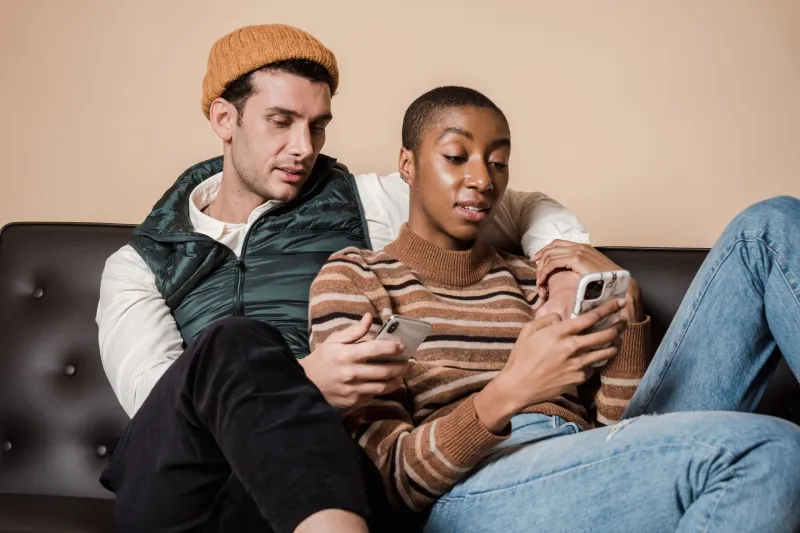
The Friend You Met at the Party Still Texts Back — And That's Not a Coincidence

Let's paint a picture. You're at a house party — maybe it's a friend's birthday, maybe it's a work happy hour that turned into an actual good time. Someone across the room is wearing a shirt from a band you thought only you cared about. You walk over. You talk for two hours. You exchange numbers. Three years later, that person is still one of your most reliable contacts — someone who hypes your posts, sends you job leads, and actually shows up when you move apartments.
Now contrast that with the person who slid into your follows after you both liked the same tweet. You followed back. They seemed interesting. You exchanged maybe four comments over the course of a year. And then — nothing. They're still technically in your network, but you couldn't tell someone their last name if your life depended on it.
This isn't just your experience. It's practically a pattern at this point. And there's real psychology behind why it happens.
Context Is Everything — And the Internet Has Almost None of It
When you meet someone in person, you're absorbing a ridiculous amount of information all at once. You hear how they laugh. You notice whether they make eye contact or stare at their phone. You pick up on the way they treat the people around them. You share a physical space, a moment in time, maybe even a drink. All of that context gets stored somewhere in your brain, and it becomes the foundation for how you understand that person going forward.
An online-only connection skips almost all of that. What you get instead is a curated highlight reel — a profile photo they probably chose carefully, a bio they rewrote six times, and whatever content they've decided to put out into the world. That's not nothing, but it's also not the same as actually knowing someone. You're essentially building a relationship on a press kit.
Psychologists call this the "mere exposure effect" — the more familiar something feels, the more we trust it. And there's no faster way to create genuine familiarity than sharing physical space with another human being. The internet can extend a relationship, but it struggles to create the same depth from scratch.
Why the Friend-of-a-Friend Introduction Is Basically Cheat Codes
Here's something worth thinking about: some of the strongest connections in your network probably didn't come from cold follows or algorithmic recommendations. They came from someone vouching for someone else.
When a person you already trust says "you have to meet my friend, you two would get along," they're doing something powerful. They're transferring a portion of their own credibility to a stranger. You walk into that introduction already primed to like the person, already curious, already open. The relationship starts with a built-in head start that no mutual follow can replicate.
This is also why LinkedIn cold outreach has such a rough success rate while a warm introduction from a shared contact can open almost any door. It's not about the platform — it's about the trust chain. Real-world introductions are almost always warm by nature. Online-only connections usually start cold and have to work a lot harder to warm up.
The Algorithm Doesn't Know What You Actually Need
Social platforms want you to believe they're good at connecting you with the right people. And sure, sometimes they nail it — you find a niche community, a creator who speaks your language, a thread that leads you to someone genuinely interesting. That happens.
But the algorithm is optimizing for engagement, not compatibility. It's surfacing people who are likely to get a reaction out of you, not necessarily people who are going to show up for you when something real happens in your life. Those are two very different things, and it's worth being honest about which one you're actually getting most of the time.
The people who started offline — who you met through lived experience, shared environments, real-world communities — they came into your life through a filter that's actually pretty hard to game: mutual human judgment. Someone decided you were worth introducing. That carries weight that no recommendation engine has figured out how to replicate yet.
So What Do You Actually Do With This?
This isn't a call to log off forever or to write off every online friendship you've ever made. Plenty of relationships that started online have grown into something genuinely meaningful. The internet has been a lifeline for people who didn't have access to their community in their immediate physical world — and that matters enormously.
But if you're trying to build a network that actually functions — one that supports your career, your mental health, your creative life, your sense of belonging — it's worth being intentional about where you're investing your energy.
A few things worth considering:
Get yourself in rooms. It sounds almost embarrassingly simple, but showing up to things — local events, industry meetups, friend-of-a-friend hangouts, even the work thing you were going to skip — creates opportunities for the kind of organic connection that algorithms can't manufacture.
Use the internet to deepen, not just to collect. When you do meet someone in the real world, the online layer becomes genuinely useful. You can stay in touch across distance, share things that remind you of each other, keep the connection alive between in-person moments. That's the internet doing what it does best.
Stop treating follower count like a measure of your network's health. A thousand followers who don't know your name is not a network. Five people who would answer your call at 11pm on a Tuesday — that's a network. Quality of connection is not a numbers game, no matter how many times the platforms try to convince you otherwise.
Look for the warm introduction. When you want to connect with someone new — professionally, socially, creatively — ask yourself if there's a person in your existing circle who could make that introduction. A warm handoff is almost always more effective than a cold follow.
The Network That Actually Has Your Back
At the end of the day, the connections that tend to matter most are the ones built on something real — a shared experience, a mutual trust chain, a moment of actual human presence. That's not a knock on digital friendships. It's just an honest assessment of how relationships tend to work when you zoom out and look at the long game.
Your most valuable contact might not have the biggest following. They might not even be that active online. But they remember meeting you. They remember the conversation. And when something comes up — an opportunity, a crisis, a reason to reach out — they actually do.
That's what a real network feels like. And more often than not, it started somewhere with no wifi.